Because everyone loves a good story
Sail Away: Tolkien’s Frodo and Tennyson’s Ulysses
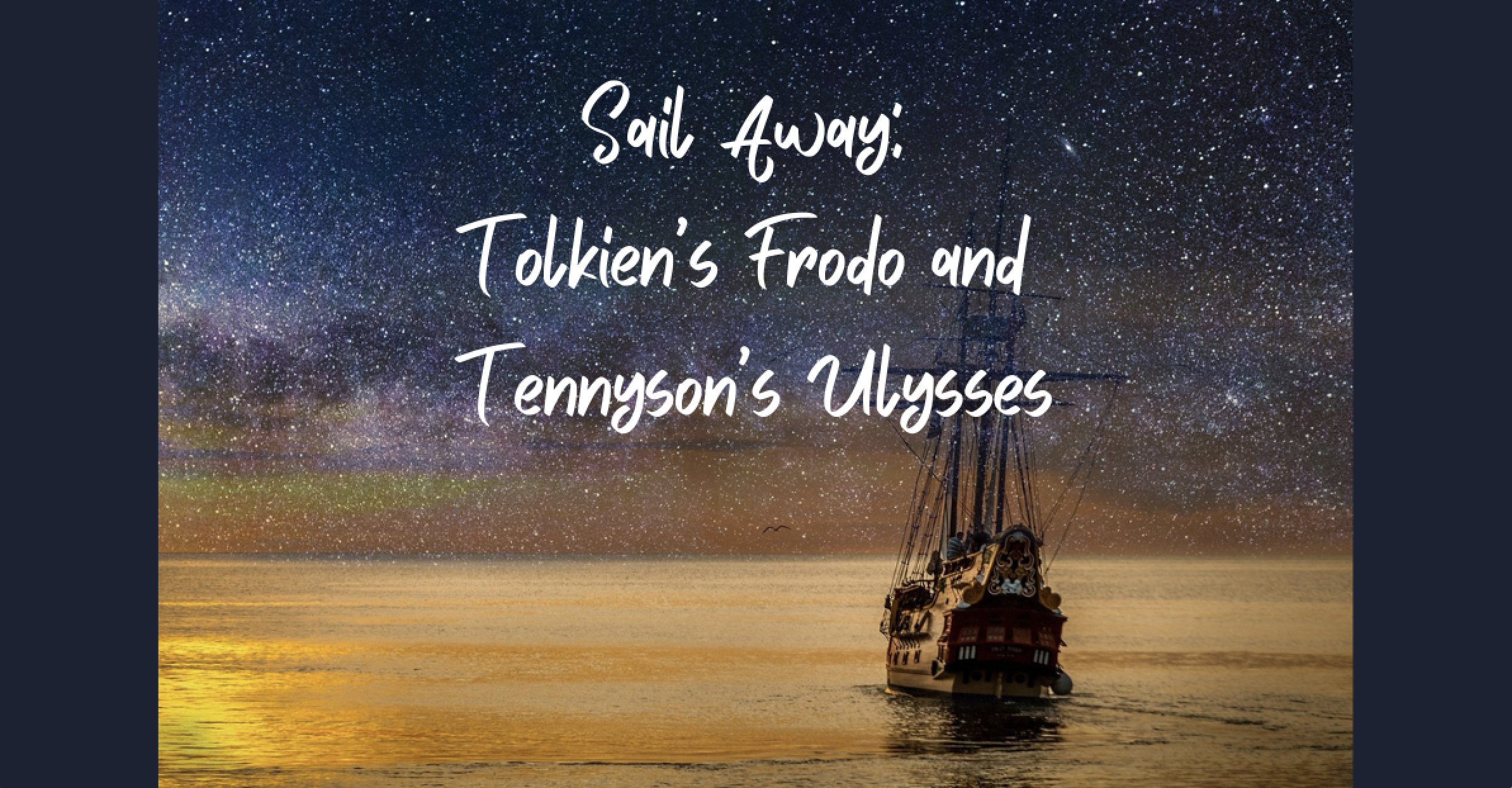
It would be hard to think of two more opposite characters than Homer’s Odysseus (aka Ulysses) and Tolkien’s Frodo Baggins. Odysseus is a mighty warrior, a fierce battle commander, a gutsy sailor, and a vicious avenger. He has no problem stabbing a giant cyclops in the eye with a burning stake so he and his friends can escape. Frodo, on the other hand, is an unassuming hobbit of the Shire, a reluctant hero, a lover of comfort, and the soul-weary bearer of a great burden. The most excitement he ever wanted was an occasional display of Gandalf’s fireworks.
And yet, as I thought about the poem “Ulysses” by Alfred, Lord Tennyson, I realized that his depiction of the ancient Greek hero has something important in common with Tolkien’s homebody hobbit. If you haven’t read “Ulysses” yet, take a minute to do it now. It’s not very long, and you’ll be glad you did it. You’d be hard pressed to find a manlier and more inspiring poem.
Odysseus’ Quest for Home
So why was I thinking about “Ulysses” at all? First, it’s one of my favorite poems of all time. Seriously, it’s so manly. That last stanza? Whew! Second, I recently finished reading Homer’s The Odessey, and it got me thinking about the hero. Tennyson’s poem is a conjecture about the latter days of Ulysses. After a decade of combat, strategy, and slaughter during the Trojan war, Ulysses spends another decade struggling against countless obstacles and setbacks on his quest to get home to his beloved wife Penelope and son Telemachus.
When Ulysses finally gets there, he has to purge Ithaca of wasteful, boastful men. Over 100 suitors had been courting Ulysses’ wife (against her will) and wasting Ulysses’ estate. He and Telemachus, along with two faithful servants, slaughter every one of them. At last, after more than two decades of struggle, Ulysses finally has what he’d longed for: a peaceful life at home with his family.
Frodo’s Longing for Hobbiton

This made me think of Frodo. After being thrust into a position of responsibility for the ring, Frodo embarks on a quest that takes just over a year. That doesn’t seem long, but I’m sure it’s worth a couple of decades in Hobbit years. (Any time a hobbit spends away from hearth and home has to be reckoned in something like dog years, right?) And it’s not so much the time that wears down his soul; it’s the terrifying experiences and the evil of the ring itself. Frodo eventually gives up hope of returning to Hobbiton alive, but by the slenderest of miracles he makes it home in the end.
But, like Ulysses, he doesn’t arrive to find the idyllic scene he’d been dreaming of. Instead, he and his friends set about “scouring the Shire” of the evil that had been lurking there too. Once that work is done, Frodo finally has everything he’d wanted. The world is safe, and he is home.
Restless in Ithaca
But after a while, these reunions aren’t enough for our heroes. They long to sail away, but for opposite reasons: the warrior wants adventure, and the hobbit wants healing. First, Tennyson’s poem is written from the viewpoint of Ulysses as an old man. The first lines show exactly how this battle captain would have felt amidst monotonous tranquility.
It little profits that an idle king,
By this still hearth, among these barren crags,
Match’d with an aged wife, I mete and dole
Unequal laws unto a savage race,
That hoard, and sleep, and feed, and know not me.
After two decades of action, Ulysses feels restless making trivial laws and quelling petty squabbles. He wants to get back out into the action.
Leaving the Shire
On the other end of Middle Earth, Frodo feels equally restless. The experience of war and the memory of evil have left him scarred—literally. The wound from a cursed knife still causes him pain. While Merry, Pippin, and Sam have joyfully resumed their lives in Hobbiton, Frodo feels broken and disconnected. He’s been too deeply changed to pick up where he left off. After a few years, he decides to sail away to the Undying Lands with the last of the elves.
Sam is heartbroken, saying, “’I thought you were going to enjoy the Shire, too, for years and years, after all you have done.’” But Frodo replies, “So I thought too, once. But I have been too deeply hurt, Sam. I tried to save the Shire, and it has been saved, but not for me. It must often be so, Sam, when things are in danger: some one has to give them up, lose them, so that others may keep them.” So he sails to Valinor in search of healing and peace.
Setting Sail
And do our heroes get what they set out for? Indeed they do. Odysseus puts his son in charge of the kingdom and rallies his fellow warriors for one final quest: to see where the winds of fate will blow them before the final sunset. “You and I are old,” he tells them,

[But] we are
One equal temper of heroic hearts,
Made weak by time and fate, but strong in will
To strive, to seek, to find, and not to yield.
And dear little Frodo sails from the shores of the familiar into the unknown, trusting that peace will find him at the journey’s end. And so it does. As he sails, “the grey rain-curtain turned all to silver glass and was rolled back, and he beheld white shores and beyond them a far green country under a swift sunrise.” To his heart, that was better than adventure, better than fireworks, and even better than home.
The Deeper Longing
After their harrowing journeys, both heroes return home but find that it isn’t really home that they’d been longing for. They feel what each of us suspects: that the deepest satisfaction and fulfillment can’t be found on these shores. They were longing for something beyond home—beyond the world’s end—and they set sail to find it.
The fulfillment of our hopes can’t be reached by a ship, but they’re even worthier of pursuit. As C.S. Lewis says, “If I find in myself desires which nothing in this world can satisfy, the only logical explanation is that I was made for another world.” May we, like these heroes, boldly seek it with all our hearts.


Add a comment, and join the conversation!