Because everyone loves a good story
Jesus, the Bronze Serpent, and John 3
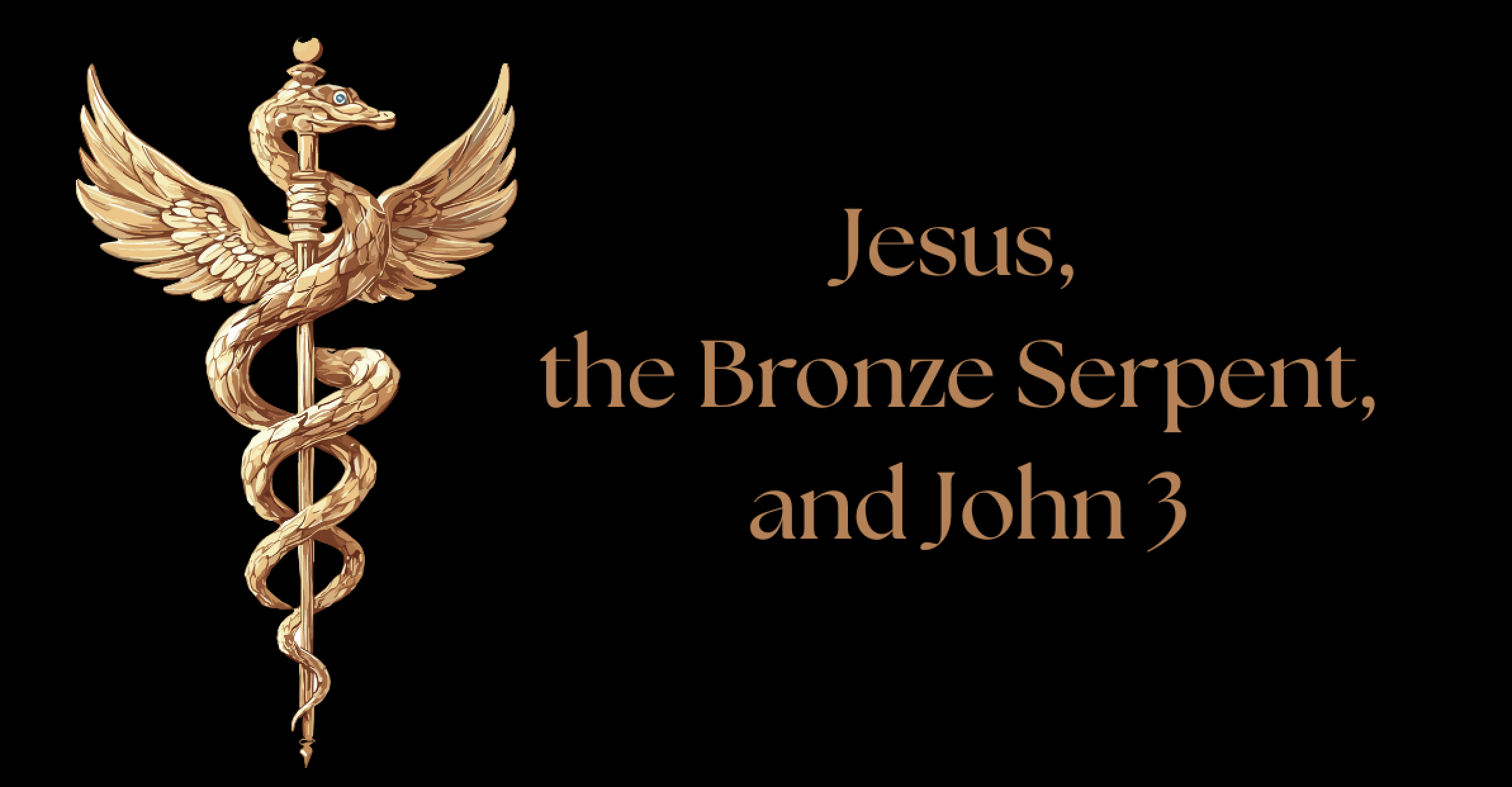
I love the way the way the New Testament doesn’t negate the Old Testament but puts the finishing touches on it instead. The miracles and stories in the Pentateuch and prophets are marvelous on their own, but they make so much more sense when Jesus arrives on the scene.
I’m reading through the Gospel of John (yes, again), and Jesus is blowing my mind with all his assertions. He’s constantly referencing stories about the patriarchs of Israel, and his Jewish audience is totally tracking with him. But then Jesus flips the story on its head and basically says, “Yes, that story was cool, but the main reason the Father did that back then was so that I could do it better now.” Oh boy. The religious leaders of Jesus’ day didn’t like that very much.
Water and Bread
I’ll give you a few examples from the first chapters of John. When Jesus is talking to the Samaritan woman at the well, he offers her living water. She says, “What, do you think you’re better than our father Jacob? He’s the one who dug this well, you know.” Instead of backing off or answering demurely, Jesus shocks her by saying, “I’m so much greater than Jacob that I could dig a well in your heart and satisfy you with living water forever.”
Soon after that, Jesus miraculously feeds thousands of people from just a few loaves and fish. The crowd follows him the next day, hoping for more handouts. They said, “Moses gave our fathers manna in the wilderness. What are you going to give us to show that you’re as good as Moses?” Jesus shocks them once again: “First of all, Moses didn’t make that manna; my Father did. Secondly, your fathers ate it, and it eased their hunger for a while, but they still died in the end. I can give you bread that will bring eternal life.” Of course they start looking around for that kind of bread, but Jesus says, “It’s right here. I’m the bread.” And if they’re not confused enough, he leaves their heads spinning with this doozy: “If you eat my flesh and drink my blood, you’ll live forever.”
A Story and a Symbol

But one of my favorite symbols is the bronze serpent. In Numbers, Moses is leading the people of Israel through the desert, and—no shocker here—they’re complaining again. As a judgment, God causes venomous serpents to infiltrate the camp and bite loads of people. That brings them to repentance pretty quickly, and they beg Moses to ask God for mercy.
In answer, God doesn’t eliminate the snakes; instead, he makes a way for the dying people to live. He tells Moses to hang a bronze serpent up high on a pole where anyone can see it if they look up. That’s all they have to do. They don’t have to crawl to it, touch it, make an offering to it, or anything. All they have to do is look. That saved countless Israelites that day, but it also set the stage for something even more beautiful later on.
The Story Becomes a Prophecy
In John 3, Jesus is talking with Nicodemus about how to have eternal life. Jesus says something strange yet again: “You must be born again.” He doesn’t mean bodily re-exiting your mother. He means that our dead hearts need to start beating and our dead spirits need to have life breathed into them. Nicodemus is baffled about how to be born again, and he says so. Jesus clarifies by alluding to the story of the bronze serpent. “Just as Moses lifted up the snake in the wilderness, so the Son of Man must be lifted up, that everyone who believes may have eternal life in him” (John 3:14-15).
…Wow! Jesus prophecies that he himself—the Son of Man—will become the serpent on the pole in order to bring eternal life to all who believe. There is just so much here, I don’t even have time (or wisdom) to unpack it all. But Jesus deepens and enriches the story of the bronze serpent by showing that we, like the Israelites, are dying in our sins, and the only remedy is to look to Jesus, the One who will be hung on the cross to bring us peace. This is one of those statements that doesn’t make sense to his audience until later, but we can see it with 20/20 hindsight in the Bible. Like the snake, Jesus was lifted up to bring us life.
The Prophecy Is Fulfilled
But wait. Why a snake? Isn’t the snake a symbol of Satan? Yes, exactly! Galatians 3:13 says, “Christ redeemed us from the curse of the law by becoming a curse for us. For it is written: ‘Cursed is everyone who is hung on a tree.’” God cursed the serpent in the garden of Eden, and he said that everyone who was hung on a tree to die was also cursed.

But I’ve wondered why God told Moses to hang a snake for the Israelites to look at. Snakes were the problem! Why make them part of the solution? Why not hang up a bronze Band-Aid or a bronze bottle of antidote or something? But God wanted us to see the parallels between these stories. “The wages of sin is death,” (Rom. 6:23), and we’re all dying in our sin. But Jesus took the sin and death on himself, becoming accursed for us so that we can live in him! He became the snake to free us from the venom. All we have to do is look.
Look to Jesus
Most people have heard John 3:16 before, but did you know it’s the very next verse after this discussion of the serpent on the pole?
“Just as Moses lifted up the snake in the wilderness, so the Son of Man must be lifted up, that everyone who believes may have eternal life in him.” For God so loved the world that he gave his one and only Son, that whoever believes in him shall not perish but have eternal life.”
So how does a spiritually dead person get born again? How does someone dying of sin’s venom get eternal life instead? By looking to the one who was made a curse in our place. By believing that the death of Jesus gives life to the dying. Not by doing anything—crawling to him, touching him, or working for him. Simply by looking at the cross and believing that Jesus died to forgive us. That’s why God healed the Israelites with a bronze serpent on a pole—so that thousands of years later we can look at the story, see Jesus in it, and rejoice in our God in an even deeper way.
2 Comments on “Jesus, the Bronze Serpent, and John 3”
Want to leave a comment?

Like you, I love the snake-on-a-stake, analogy, part of the biblical uplifting (hupsō) theme. But I demure on a couple of biblical citations.
First, “born again” (Jhn. 3:3) is a lousy translation, and reflects Nicodemean humour—reincarnation. Jesus tested by ambiguity, “born anew”. Nicodemus failed by, “What, born again?”. Jesus clarified by, “No you twit, born from above”.
Gal. 3:13 as “a curse” is a lousy translation (along with “became sin”), and yields a false narrative. Paul likened Jesus with others who too had become accursed (a verb, not a noun), only Jesus having become accursed (and a sin offering) for us, not for any misdeeds of his own.
A spread of English Bible versions on both these texts (including Tyndale), will yield this more theological result.
Thank you for these insights! The more we can get into the original language and intents, the clearer the intentions become. Thanks for helping shed some light here!